Ibiza
Game
An open-world game that doesn't exist. We took five years of our own documentary photography of Ibiza and turned it into playable terrain: twenty-two shots, one consistent protagonist, a custom interface, an original song and a 64-second film cut to the beat.
Ibiza · Balearic Islands · Spain
- Type
- Concept project, no client brief
- Role
- Art direction, production and edit
- Source material
- 5+ years of our own photo archive
- Year
- 2026
Sixty-four seconds
It looks like real gameplay. It isn't a game: every element in it was designed and directed by us. Sound on.
A clear idea before every image
The goal was never to imitate an existing game. It was to design a visual property of our own that turns real places into playable terrain.
We started by chasing maximum realism. Seeing the first scenes side by side, several of them read as retouched photography rather than a captured frame from a game. We corrected course and fixed the ratio that governs the whole piece: 70 % video game, 30 % reality.
- Ratio
- 70 % video game, 30 % reality
- Camera
- Third person, shoulder height
- Leads on screen
- Exactly one
What is preserved
- Architecture and geography
- The horizon line
- Graffiti, lighthouses and signage that belong to the place
- The colour and the hour of the original photograph
What is transformed
- Materials and graphic finish
- Atmosphere and cinematic lighting
- Interactive elements
- People, rebuilt as characters inside the same world
One camera
Third-person game camera at shoulder height, the same framing and the same scale in every scene.
One engine
Materials, contrast and atmosphere stay consistent across the whole island, as if rendered by the same engine.
One protagonist
Exactly one. No second lead, no faces competing with him, no trend effects that would date the piece.
Every place starts from a real photograph
The photograph is in charge. Its structure survives; its finish is redesigned. If a scene stops reading as the same place, we go back to the original and start again.
- Input
- Our own photographs
- Decision
- What is kept, what is rebuilt
- Output
- 22 scenes
Capture
A photograph is chosen for depth, visual interest and narrative potential.
Analysis
Vanishing lines, light, scale, and where the character or the vehicle will stand.
Transformation
Structure preserved, finish rebuilt: materials, atmosphere and interactive detail.
Manual check
Coherence, colour balance and readability, verified against the original frame.
Drag the handle to compare
Es Vedrà
The silhouette, the horizon and the hour of the sunset are untouched. What changes is the ground, the vegetation and the road that now runs through the frame — and the interface that tells you someone is driving it.
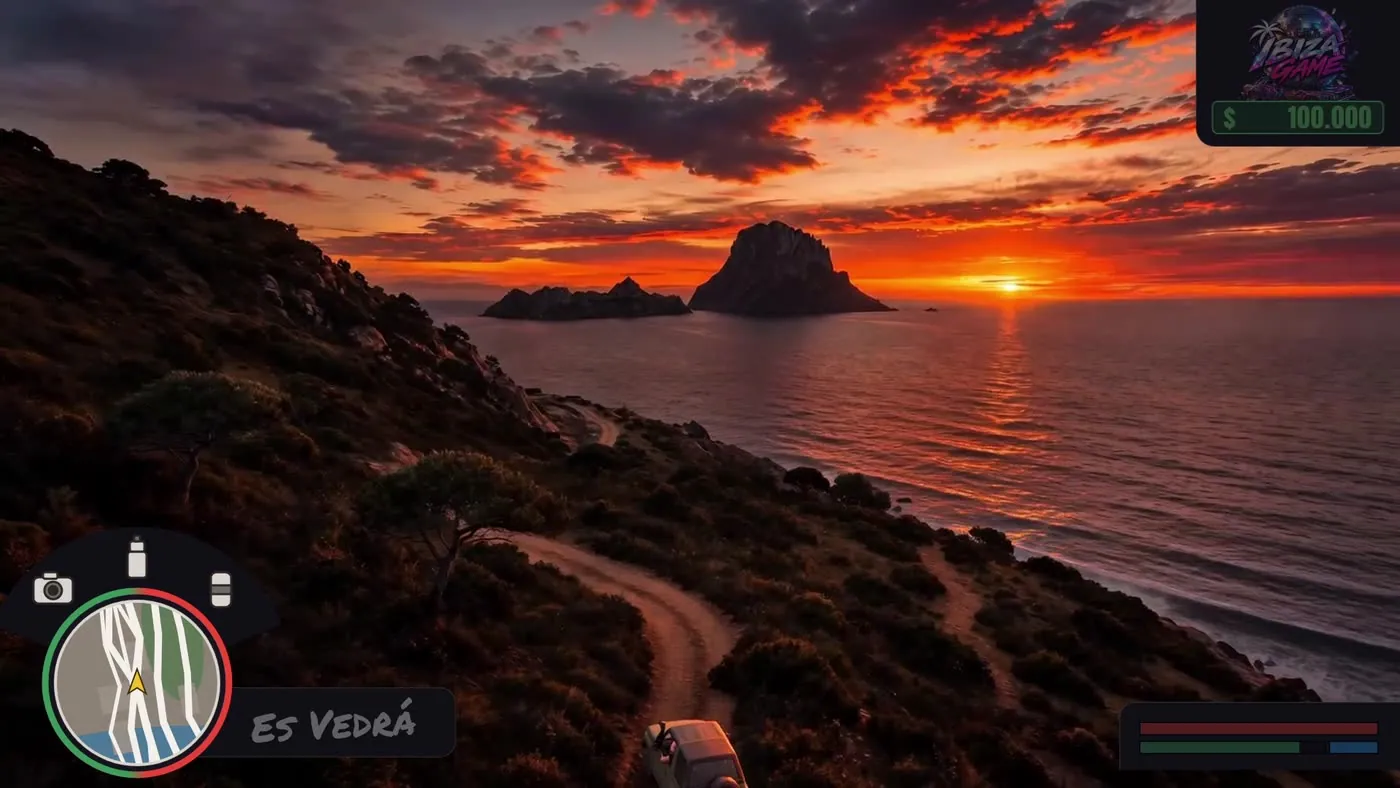
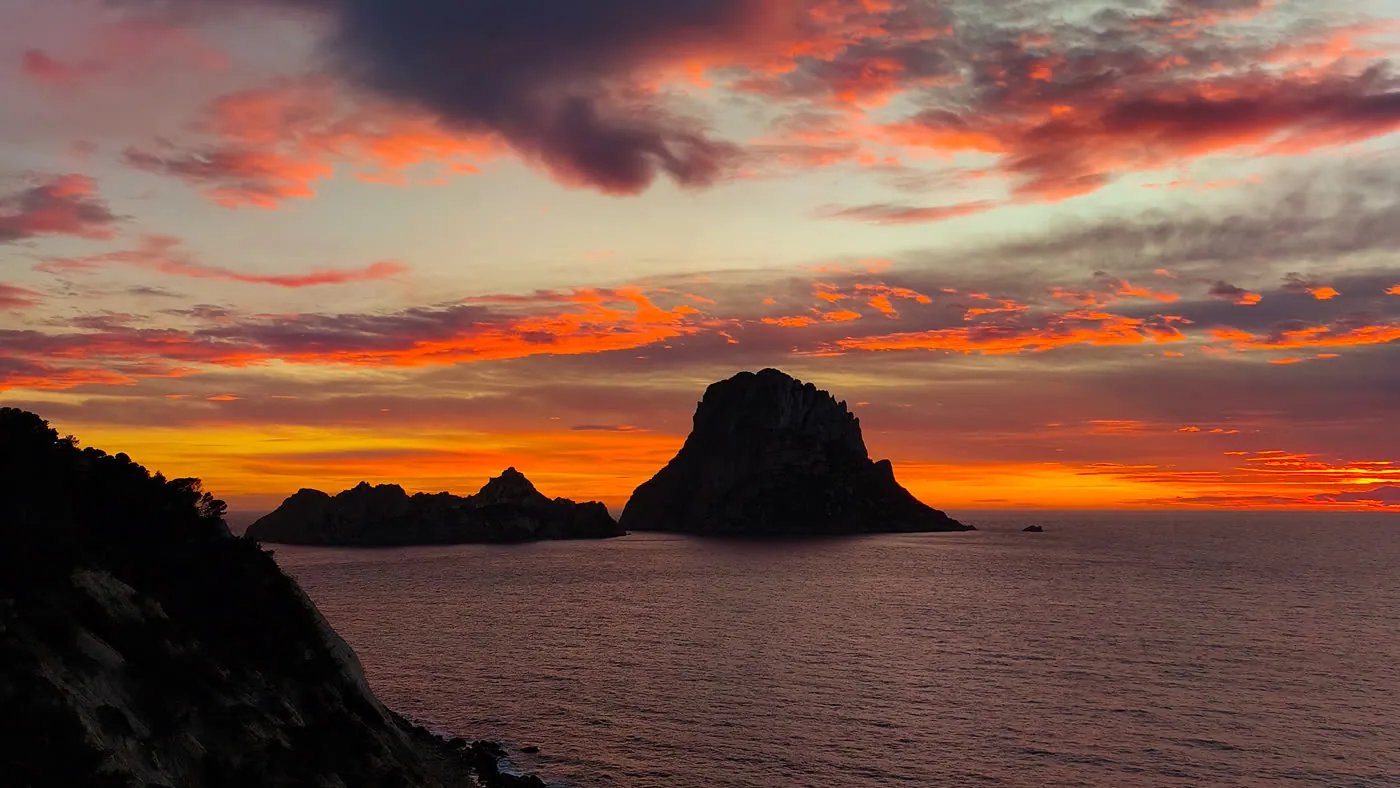 PhotographScene
Ibiza Style
A real wall, with real graffiti, in a real spot on the island. It stays exactly where it was: the signature of the place becomes the signature of the world. The hour moves from midday to late afternoon, and the character arrives with his vehicle.
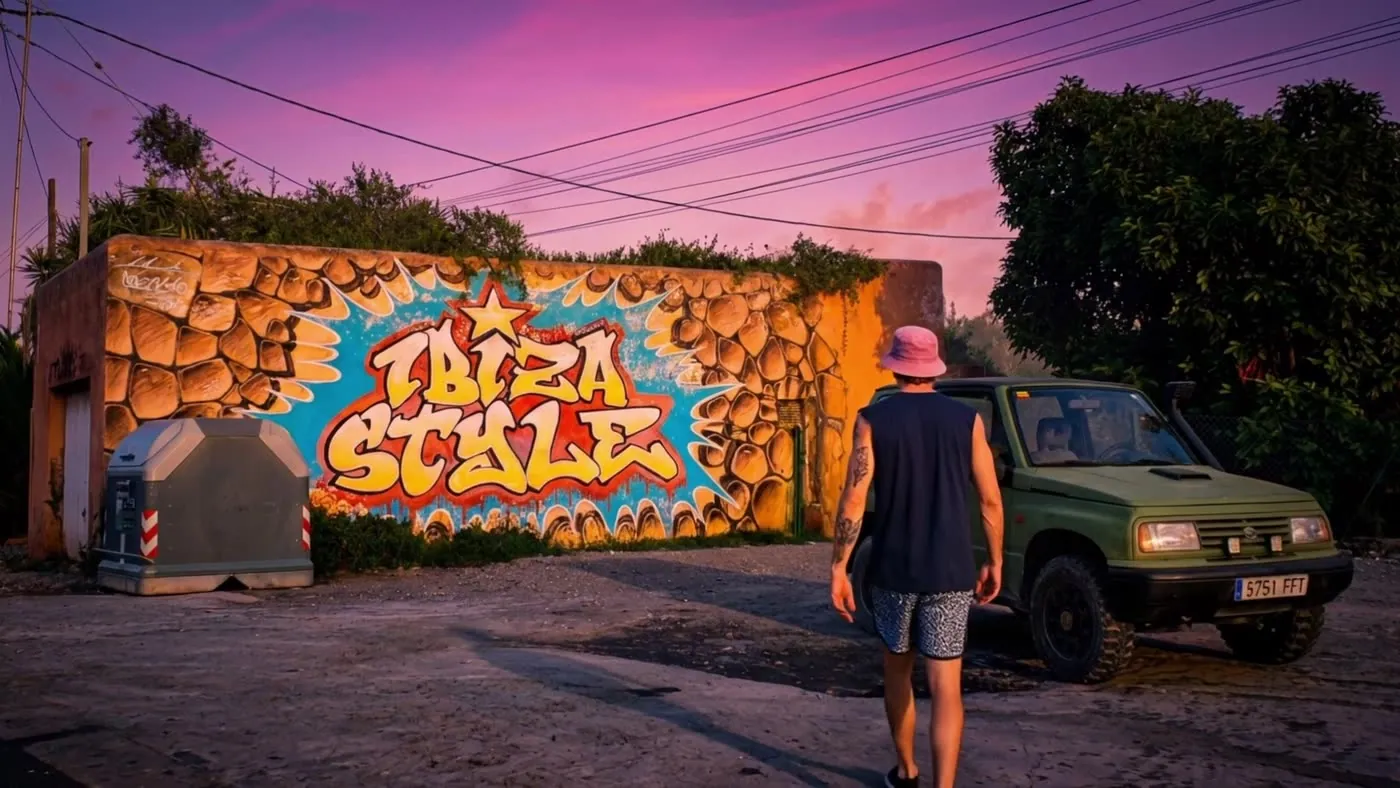
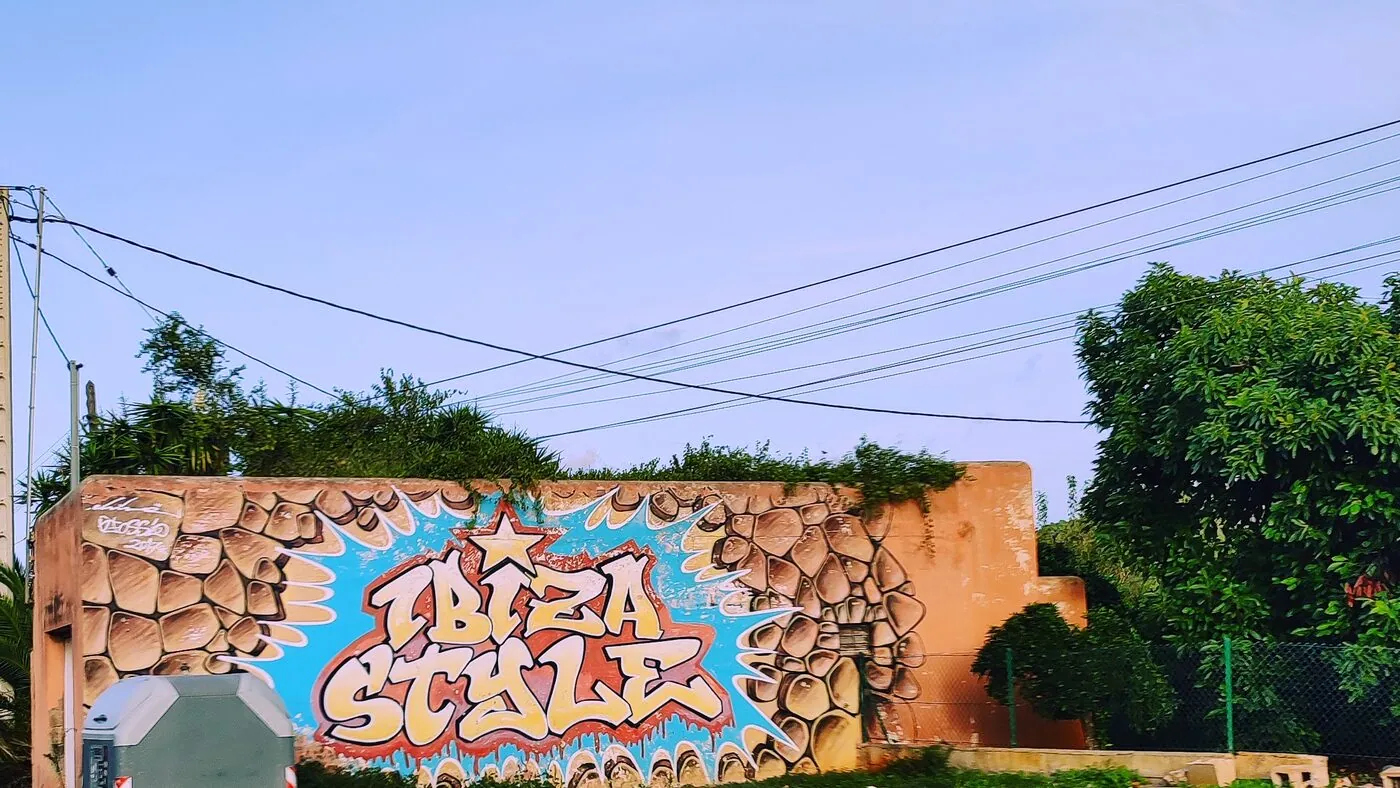 PhotographScene
Partial eclipse
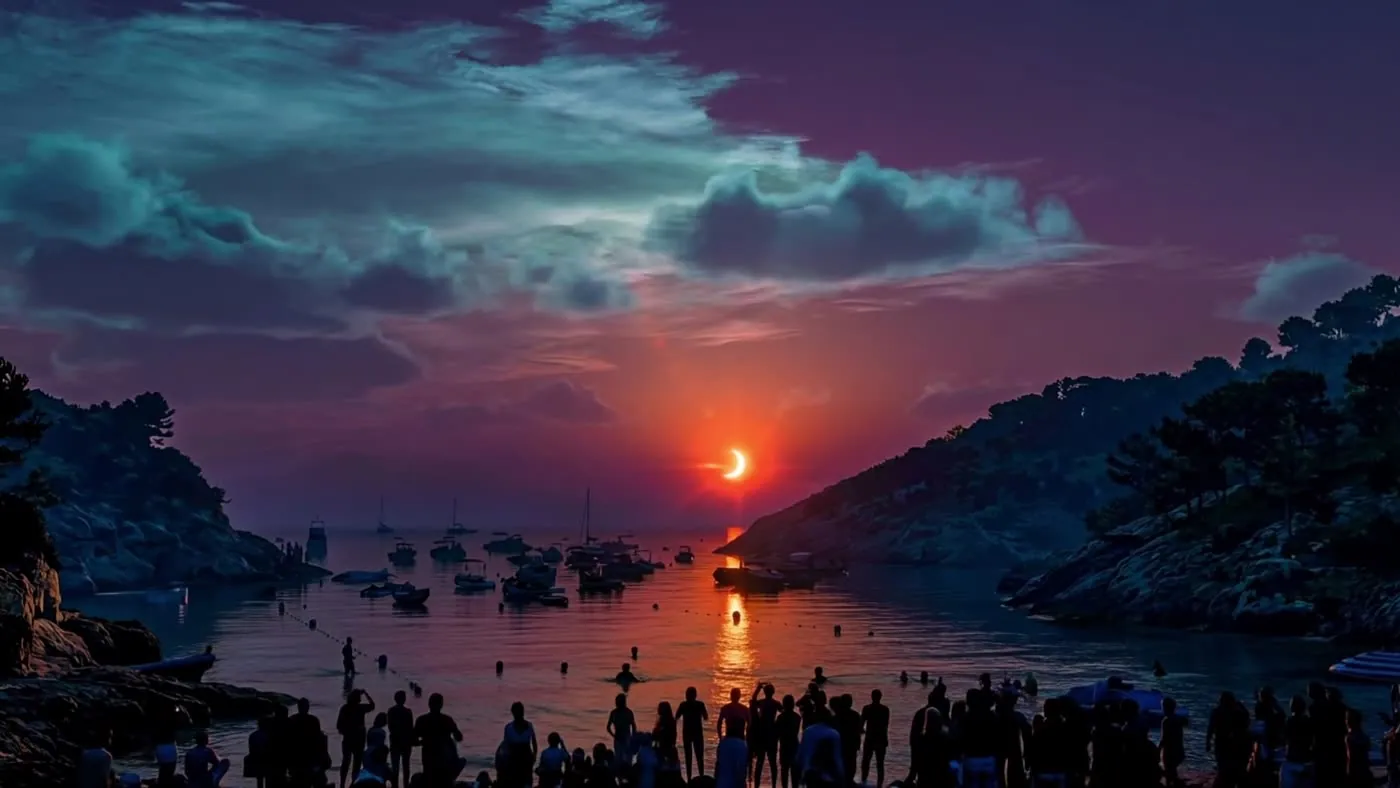
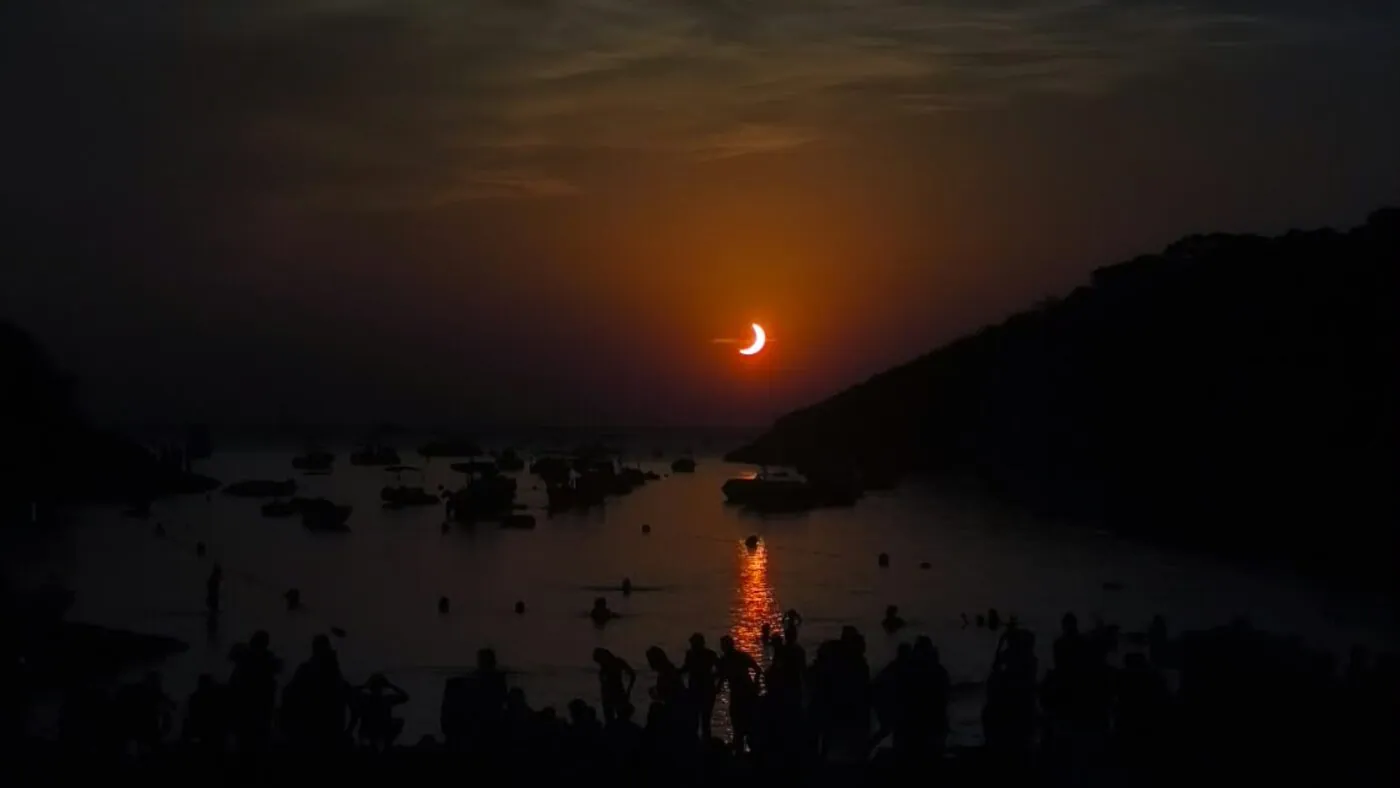
The hardest kind of photograph to transform: almost no light, almost no detail, and a crowd of silhouettes that has to survive the rebuild without turning into a crowd of strangers. The eclipse is the only moment in the film where the interface disappears.
 PhotographScene
The goodbye
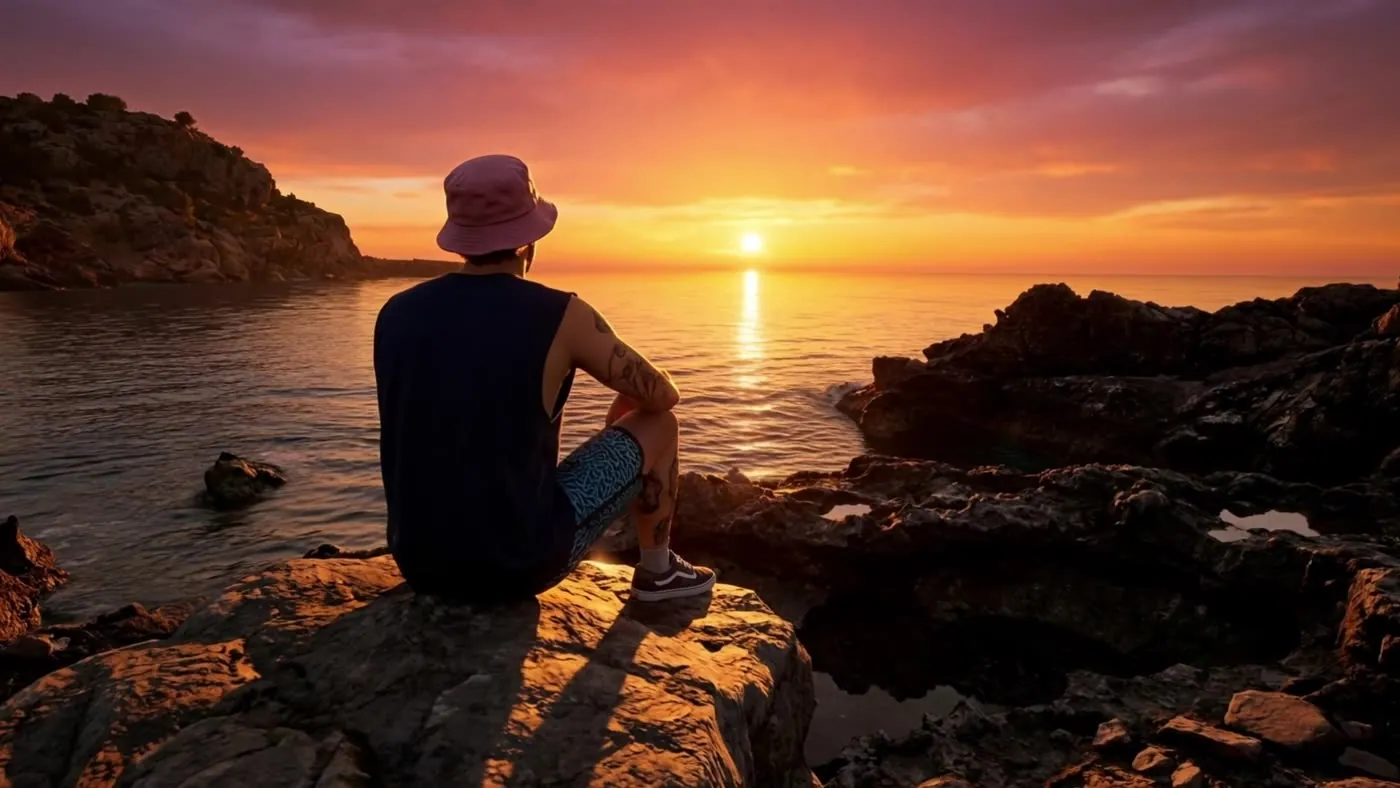
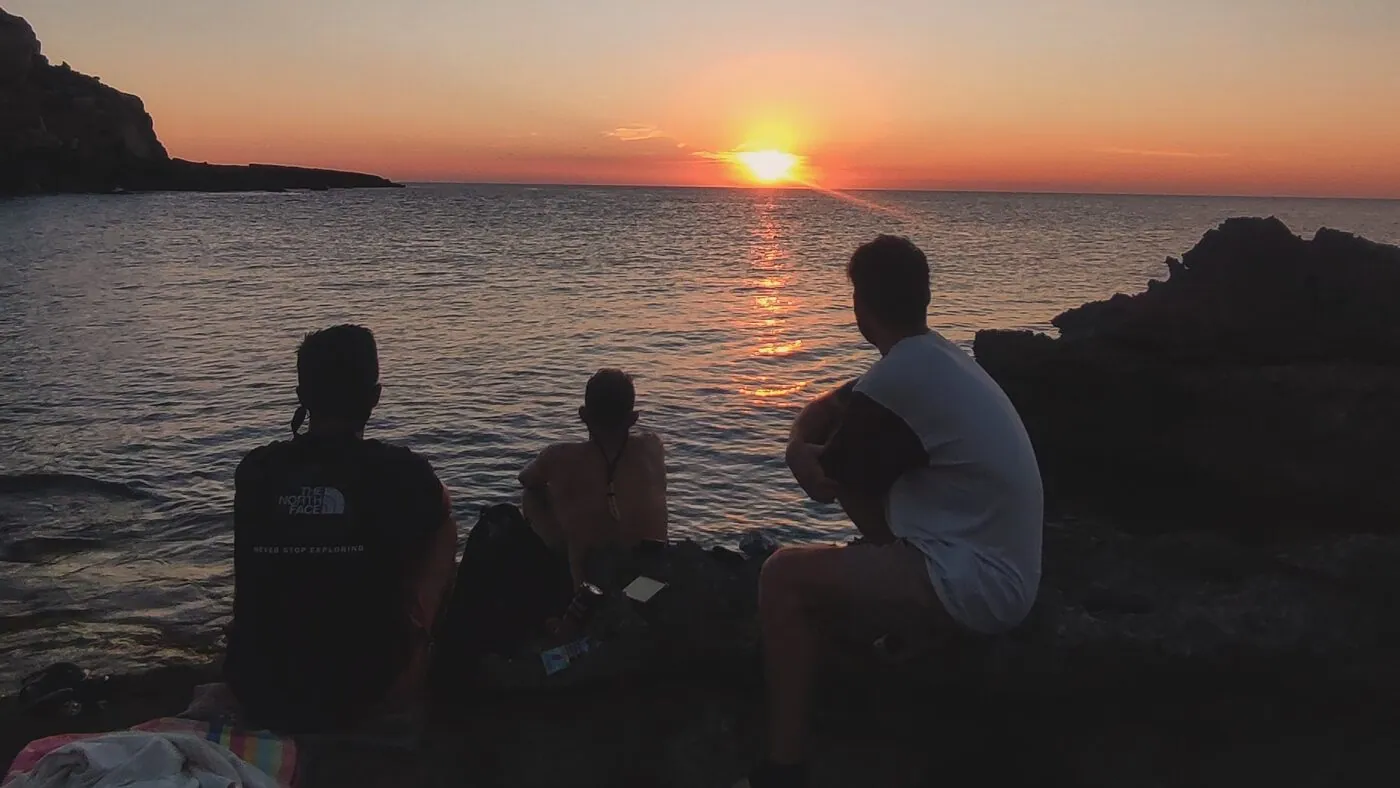
Three friends watching the sun go down become one protagonist watching it alone. The rule that there is exactly one lead in every frame is what turns a holiday photograph into the last shot of a story.
 PhotographScene
From a real person to a stable protagonist
Nacho comes from real photographs, used with his permission. For him to hold his identity across hundreds of generations, we built a closed character sheet and treated it as law: every image is checked against it before it enters the edit.
- Input
- Real photographs of the protagonist
- Decision
- A closed character sheet
- Output
- The same man in any light
What the sheet defines
- Features and silhouette, with fixed proportions
- Pink bucket hat, navy tank top, dark patterned shorts
- Specific trainers, down to the colourway
- Wayfarer sunglasses, no logos
- Symmetrical tattoos on the left leg
What is checked in every shot
- Same identity in daylight, night and club light
- Correct human scale against the environment
- Light direction and perspective integrated
- Exactly one protagonist on screen
- Back to camera in almost every shot, as in a third-person game
A world that moves
With a vehicle, the project stopped being a walk between locations and became a journey across an island: driving, transitions, and a pursuit. The vehicle gets the same treatment as the character — a closed sheet, and a camera rule that never changes.
The sheet does not inherit itself. A vehicle is re-scaled and re-lit in every scene, and the details that tend to disappear — the spare wheel, the alignment with the road — are requested explicitly and verified by eye.
- Camera rule
- Always behind the vehicle
- Sheets
- Two vehicles
- Check
- Re-scaled and re-lit per scene
Decisions, not perfection
One key frame was approved as it was, even though the protagonist didn't sit perfectly in the seat. The shot lasts four seconds on screen. We chose not to spend more production on it, and we'd make the same call again.
Written before it is produced
Order, duration, intent and interface figures are written down before a single frame is generated. Every euro of production serves a scene we already know the place of.
An interface and a brand of our own
A recognisable interface is what convinces a viewer they are looking at a game. Borrowing a commercial one would have turned the piece into a legal liability. So the logo, the HUD, the icons and the typography are original.
The interface is applied in post as an independent layer. That is more stable than generating it inside each clip, and it means a name or a figure can be corrected without regenerating anything.
- Pieces
- Logo, counter, minimap, health bar
- Applied
- Separate layer in post
- Counter
- 100,000 down to 1,312
-
01Logo and counterTop right of the screen
-
02Minimap and placeThe real toponym, in marker pen
-
03Health barBottom right of the screen
A counter that tells the story
It opens at 100,000 and falls shot by shot to 1,312 in the final scene. There is no dialogue in the piece. The number is the narration.
Place names in marker pen
Each location is labelled by its real toponym, hand-lettered in a graffiti marker that belongs to the visual culture of the island rather than to a generic game font.
Four acts in one minute
Every shot lasts a multiple of half a bar. Nothing is sped up or slowed down: the rhythm comes out of the cut and the music, not out of the clips.
- Length
- 64 seconds
- Shots
- 24 with title cards
- Unit
- Half a bar
I · The world
No character. Six locations move from day to night while the song builds without drums: rock, harbour, sunset party, night pool, golden light and an empty club. The viewer gets their bearings before anyone appears.
II · The player
On the first kick drum, the protagonist enters. Orbital introduction shot, the graffiti wall as a signature, and a driving sequence towards the coast. The interface appears for the first time: the player takes control, with 100,000 on the counter.
III · Pursuit and night
A pursuit breaks the calm. Hard cuts to street, restaurant and club, with half-bar shots that accelerate the rhythm. The two party scenes run back to back and sound like a crowd with electronic music in the distance.
IV · Eclipse and goodbye
A scratch breaks the track and a partial eclipse arrives. Fast cuts through lighthouse, tavern, street and boat, and a last shot of the protagonist facing the sunset. The final card lands on the last kick.
What closes the illusion
An image can look like a game. Only sound makes it feel like one. The song, the layers and the cut were built together, and nothing in the piece belongs to anyone else.
- Song
- Original boom-bap, 94.8 bpm
- Sound layers
- Six, built separately
- Delivery
- 1080p master, 24 fps
An original song
Nineties boom-bap at 94.8 beats per minute, opening with an atmospheric intro and no drums. No samples, no reference to any existing artist.
Cut to the beat
Four seconds of silence on the loading screen, then the track starts whole. The first kick lands on the orbital shot, the scratch on the eclipse, the last hit on the final card.
Sound in layers
Slow engine on dirt, fast engine on asphalt, sirens, crowd and distant electronic music, swell and outboard motor on the water. Each one built separately and mixed by scene.
Delivery
1080p master at 24 fps with the interface kept as an independent layer, plus a light version for mobile. Five masters were checked frame by frame and level by level before the final was approved.
What stays reusable
Character and vehicle sheets, an editable interface, the shot list and the written process. The same system can be pointed at another destination, another brand or another character.
The method, not the subject
What you see here is Ibiza because Ibiza is where our archive is. Change the place for your destination, your venue or your product and the system works the same way.
Art direction
Twenty-two distinct shots that read as a single universe.
Consistency
The same character and the same vehicles in any light, place and camera distance.
Creative autonomy
Brand, interface, music and sound of our own, with no dependency on third-party rights.
Professional delivery
Master, mobile version and full documentation of the process.
What people ask about Ibiza Game
Is it a real video game?
No. Ibiza Game is a 64-second audiovisual piece that looks like open-world gameplay but is not playable. It is a concept project, made to show how a real place can be designed into a visual universe.
Where was it shot?
Every location comes from our own photographs of Ibiza, taken over more than five years: Es Vedrà, Dalt Vila, the lighthouse, the coast road, and several clubs and coves on the island.
How was it made?
Each real photograph was analysed and rebuilt as a game scene, keeping its architecture, its geography and the hour of its light. A closed character sheet keeps the protagonist consistent, the interface was designed from scratch and applied in post as a separate layer, and the whole piece was cut to an original song. Total production time: 75 hours.
Can you do this for another place or brand?
Yes. The method is independent of the subject: the same system can be pointed at another destination, a hotel, a product or a brand character. Tell us what you have in mind.
A concept project
Ibiza Game was produced without a client brief, from our own photographic archive, and we label it as such. The protagonist appears with his permission. We don't invent clients, metrics or results.